November 3, 2026
8 Red Flags to Check Before Accepting a Freelance Project
Not every freelance opportunity is worth accepting. Learn the 8 red flags to look out for before taking on a creative project, from vague briefs and unclear payment terms to scope creep and difficult
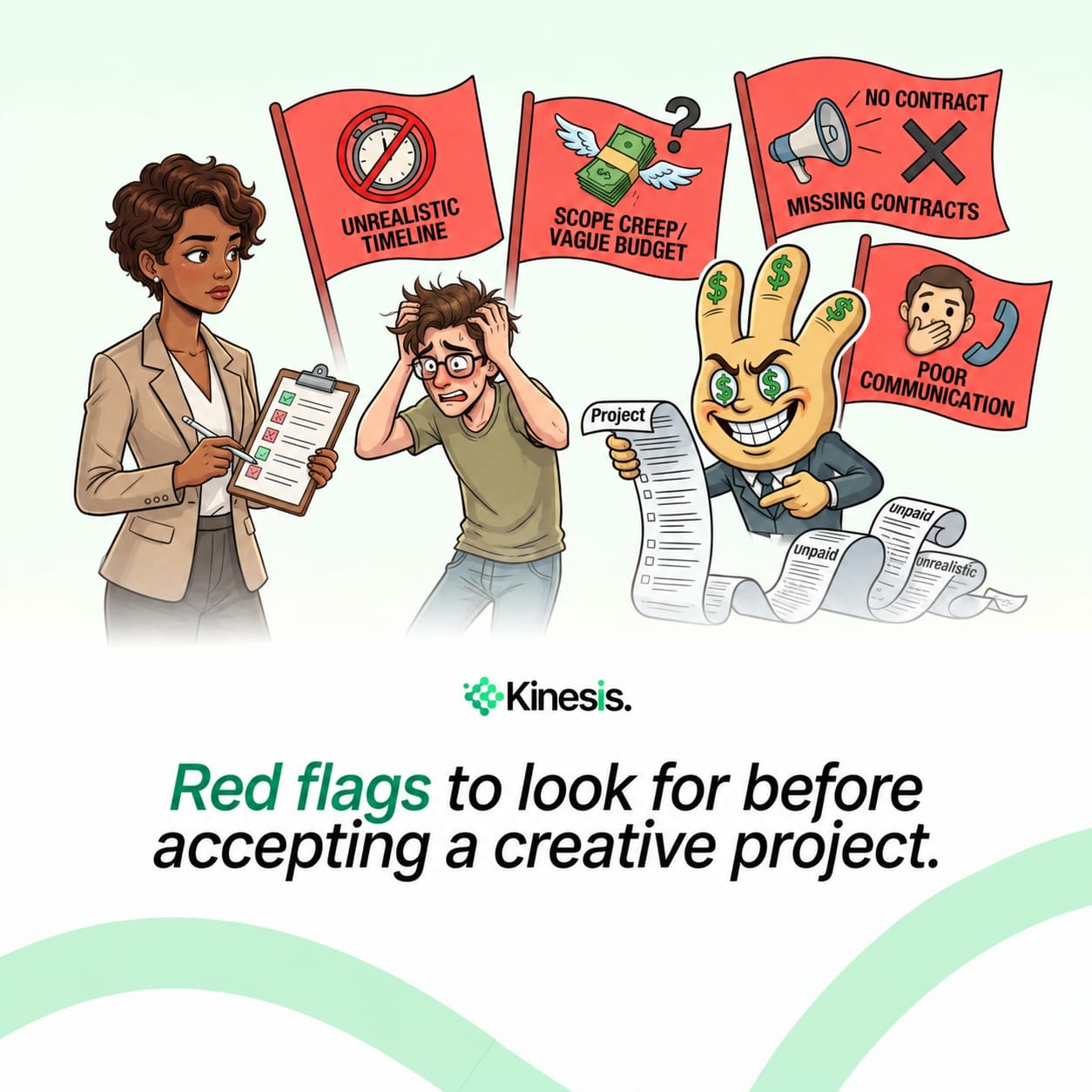
The success of a project often starts before you accept it
Every freelancer wants good clients, interesting projects, and work that pays well. But not every opportunity that comes your way is worth accepting. A client might have an exciting idea, promise a generous budget, or make the project sound like an easy win. Then, halfway through the job, things start to change. The brief becomes more complicated. Revisions keep piling up. Deadlines become unrealistic. Payments are delayed. Suddenly, what looked like a great opportunity has turned into a stressful experience. For photographers, videographers, graphic designers, motion designers, and video editors, these situations are more common than they should be. The good news is that many project problems have warning signs you can spot before agreeing to the job. Knowing what to look for can help you avoid difficult working relationships, protect your time, and make better decisions about the projects you take on.
Here are eight red flags to look out for before accepting your next freelance creative project.
1. You cannot verify who the client is
Before committing your time and resources, you should have a reasonable understanding of who you are working with. A potential client does not necessarily need a polished website, a large social media following, or a corporate email address. Independent entrepreneurs and small businesses often operate through social media and messaging platforms. However, they should be willing to provide enough information for you to establish their identity and discuss a professional working arrangement.
Pay attention if a potential client:
-Avoids providing their full name or business details when needed.-Cannot explain which company or organisation they represent.
-Uses inconsistent contact information or gives conflicting details.
-Refuses to clarify who has the authority to approve the project.
The goal is not to investigate every potential client as though they are suspicious. It is to establish enough trust and accountability before entering a business arrangement.
2. The project brief is too vague to estimate properly
"We just need something creative."
"Make it look premium."
"Do whatever you think is best."
These statements might sound like creative freedom, but they are not a substitute for a proper brief.
A vague brief makes it difficult to understand what the client expects, how much work is involved, and what you should charge. For example, a client might approach you for a promotional video without specifying its length, intended platform, target audience, visual direction, or required versions.
You could spend days creating something you believe meets their expectations, only to discover that they had an entirely different result in mind.
Watch out for:
- -No clearly defined project objective.
- -Missing information about the target audience.
- -No references or useful creative direction.
- -Unclear deliverables or technical requirements.
- -Requirements that change significantly during initial discussions.
Remember, clients do not always know exactly what they want. Part of your job as a creative professional is helping them turn an idea into a workable brief. But you should not have to guess your way through an entire project.
3. The client wants to start without agreeing on the scope
A project can begin with a simple request and gradually turn into something much bigger. A graphic designer might agree to create five social media designs, only to receive requests for additional campaign concepts, resized versions, and completely different designs halfway through the project.
A video editor might agree to edit a three-minute video, then discover that the client expects multiple cutdowns, extensive animation, and unlimited revisions. This is scope creep, and it can quickly eat into your time and profit.
Before accepting a project, make sure there is a written agreement covering:
- -The exact deliverables.
- -The number of designs, photographs, videos, or other assets.
- -The number of revision rounds included.
- -The agreed deadline and milestones.
- -What is considered additional work.
- -How changes to the original brief will be handled.
A conversation on WhatsApp or another messaging platform can help establish expectations, but make sure the final agreement is easy to retrieve and clearly acknowledged by both parties.
4. Payment terms are unclear or the client refuses to pay a deposit
Getting paid should not be an afterthought. It should be part of the conversation before you begin working. One of the biggest risks for freelancers is committing significant time and resources to a project without knowing when or how payment will happen.
Be cautious if a client:
- -Expects you to complete the entire project before making any payment.
- -Refuses to agree on a payment deadline.
- -Keeps changing the agreed payment arrangement.
- -Offers vague promises instead of a clear payment commitment.
- -Asks you to pay unexpected fees to receive a payment.
- -Sends suspicious payment confirmations or asks you to refund an alleged overpayment.
Not every project requires the same payment structure. A small design job may have a different arrangement from a month-long video production project.
However, the payment amount, method, schedule, and relevant conditions should be agreed upon in advance.
5. The deadline is unrealistic, but the client expects everything to remain normal
Some clients need urgent work. That is not necessarily a problem. The warning sign is when a client expects an unusually short turnaround without acknowledging the additional pressure, resources, or scheduling adjustments involved. Imagine a client asking you to shoot, edit, and deliver a complete promotional video within 24 hours, despite the project normally requiring several days.
Or consider a client who takes five days to approve a concept but still expects you to meet the original delivery date. Both situations can put unnecessary pressure on your schedule.
Before accepting the job, clarify:
- -When the project will begin and end.
- -When the client is expected to provide materials.
- -How quickly they should respond to questions and submissions.
- -How much time is allocated for feedback and approvals.
- -What happens when the client delays the process.
- -Whether urgent delivery attracts a rush fee.
6. Ownership and usage rights are left open to interpretation
Creating the work is one thing. Establishing what the client can do with it is another. This is particularly important for photographers, videographers, illustrators, graphic designers, and other creatives producing original content. A client may pay for a finished video and assume they automatically receive all the original footage, editable project files, and unrestricted rights to use the work. You may have a different understanding. Neither party should have to guess.
Before starting, clarify:
- -Who will own the final deliverables.
- -What usage rights the client receives.
- -Whether those rights are exclusive or non-exclusive.
- -Where and how the work can be used.
- -Whether you can showcase the finished work in your portfolio.
- -Whether raw footage, editable files, and other source materials are included.
- -Whether additional licensing or usage rights require a separate fee.
For example, your quotation for a promotional video might cover the final exported video but exclude raw footage and editable project files.
If the client requires those additional materials, you can discuss the terms and price before agreeing to the project.
7. The client's behaviour during initial discussions is already difficult
The way someone treats you before a project begins can offer useful clues about what working with them might be like. A client who dismisses your expertise, ignores reasonable questions, or expects you to be available around the clock may continue those behaviours once the project is underway.
Look out for patterns such as:
- -Constantly negotiating your rates without discussing the actual scope.
- -Expecting immediate responses at all hours.
- -Ignoring questions about important project details.
- -Speaking disrespectfully when you explain your process.
- -Repeatedly changing requirements during initial discussions.
- -Blaming previous freelancers for every problem without taking any responsibility.
- -Pressuring you to accept terms before you have had time to review them.
Of course, not every disagreement is a red flag. Clients can have budget limitations, different working styles, and legitimate concerns.
What matters is how those situations are handled.
Can the client have a reasonable conversation about pricing? Are they willing to listen to your professional recommendations? Do they respect agreed communication boundaries?
8. The project does not fit your capacity, priorities, or business goals
Not every problematic project comes with an obvious warning sign. Sometimes the client is legitimate, the brief is clear, the payment terms are acceptable, and the deadline is reasonable. Yet the project still may not be right for you. Perhaps your schedule is already full. Maybe the budget does not justify the resources required. Or perhaps the project offers little value compared with other opportunities available to you.
Before accepting, ask yourself:
- -Does the budget justify the time and effort involved?
- -Do I have the capacity to deliver quality work within the deadline?
- -Does this project align with my professional goals?
- -Will it help me develop my skills or strengthen my portfolio?
- -Am I comfortable with the client's expectations and working style?
- -What would I have to sacrifice to take on this job?
It is easy to feel pressured to accept every opportunity, especially when you are building a freelance business or trying to maintain a steady income.
But saying yes to everything can leave you overworked, underpaid, and unable to give your best to the projects that matter.
Your pre-project checklist: 8 things to confirm before saying yes
Before committing to your next creative project, run through this quick checklist.
- -I know who the client is and have reliable contact information.
- -I understand the brief, objectives, and expected deliverables.
- -The project scope, revision limits, and additional-work terms are documented.
- -The payment amount, method, and schedule are agreed.
- -The timeline accounts for production, feedback, and approvals.
- -Ownership, usage rights, and source-file delivery are clearly defined.
- -The client communicates respectfully and is willing to discuss reasonable questions.
- -The project fits my capacity, financial expectations, and professional goals.
If you cannot confidently tick one or more of these boxes, do not rush into accepting the job.
Go back to the client, ask the necessary questions, and clarify the outstanding details. If they are unwilling to address reasonable concerns, consider walking away. A promising project should not require you to compromise your professional standards just to get started.
Protect your creative business beyond the initial agreement
Some freelance problems can be avoided by asking the right questions before accepting a project. Others require good organisation throughout the client relationship. When you are managing multiple enquiries, project briefs, revisions, deadlines, and payment discussions, keeping track of everything can become difficult. Important details can get buried in long WhatsApp conversations. You might forget a client's earlier request, struggle to find an agreed deadline, or lose track of an important follow-up. This is where having a more organised way to manage client relationships becomes useful.
Manage your client relationships more easily with KinesisFlow
KinesisFlow is designed for creatives who want to manage their portfolios and client relationships through WhatsApp. With Kinexa, its AI personal assistant, KinesisFlow helps creatives manage client communication in an environment they already use, rather than constantly switching between separate tools. Whether you are handling new enquiries or keeping track of ongoing client conversations, having a more organised approach can make it easier to revisit important discussions, follow up on requests, and stay on top of your working relationships. It is important to remember that a management tool does not replace a written contract, proper client verification, or sound payment practices. Instead, KinesisFlow supports the organisation behind your creative business, helping you spend less time trying to keep track of conversations and more time focusing on your work.